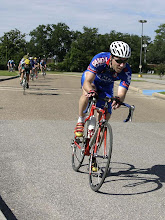


Eccentrics....bad!
In the last post, I defined the types of muscular contractions and stated that the pedal stroke is comprised of concentric contractions.
Here are some areas where eccentric contractions show up. These are caused as a result of rider being out of position or because the rider has a poor motor plan and therefore "doesn't know how to pedal".
The first situation occurs as the foot crosses top dead center and moves toward the forward position. If the heel is dropped below horizontal at the forward position, it indicates that the heel has moved faster than the pedal. To do this, the gastrocnemius has lengthened while contracting and dampened force. It has absorbed force that should have been delivered to the pedal.
The second situation occurs as the pedal is moving from the forward position to dead bottom center. For the rider that tends to mash to produce power will continue to utilized the quadriceps for too long during the down stroke. As the pedal begins to move through the down stroke, the rectus femoris remains "on" while the knee is flexing and the hip is extending. This lengthens the rectus femoris across two joints and adversely affects the center of gravity and the stability of the pelvis.
The third situation occurs when the pedal is leaving dead bottom center. If the axis of rotation is behind the bottom bracket at the point, the ankle is forced to go into eccentric plantar flexion so that the knee can be positioned for flexion as the upstroke begins. This situation is driven by position in many cases. It can also be technique driven if the rider pedals through the bottom of the stroke with the rather flat. This can cause the knee to extend too far and which places the axis of rotation behind the bottom bracket at dead bottom center.
Each of these problems causes a breakdown in the pedal stroke. Each causes the rider to dampen force or prevents their ability to ride a straight line.
Situations like these indicate why bike fitting and technique training must go hand in hand. If someone fits you to your bike, yet, they don't have an ability to assess how you are operating in that position, they are only offering a portion of service. The two must go hand in hand.
Labels: bike fitting, pedaling technique
posted by David Field, Gulf Coast Cycle Fit @ 6:03 PM
0 comments

